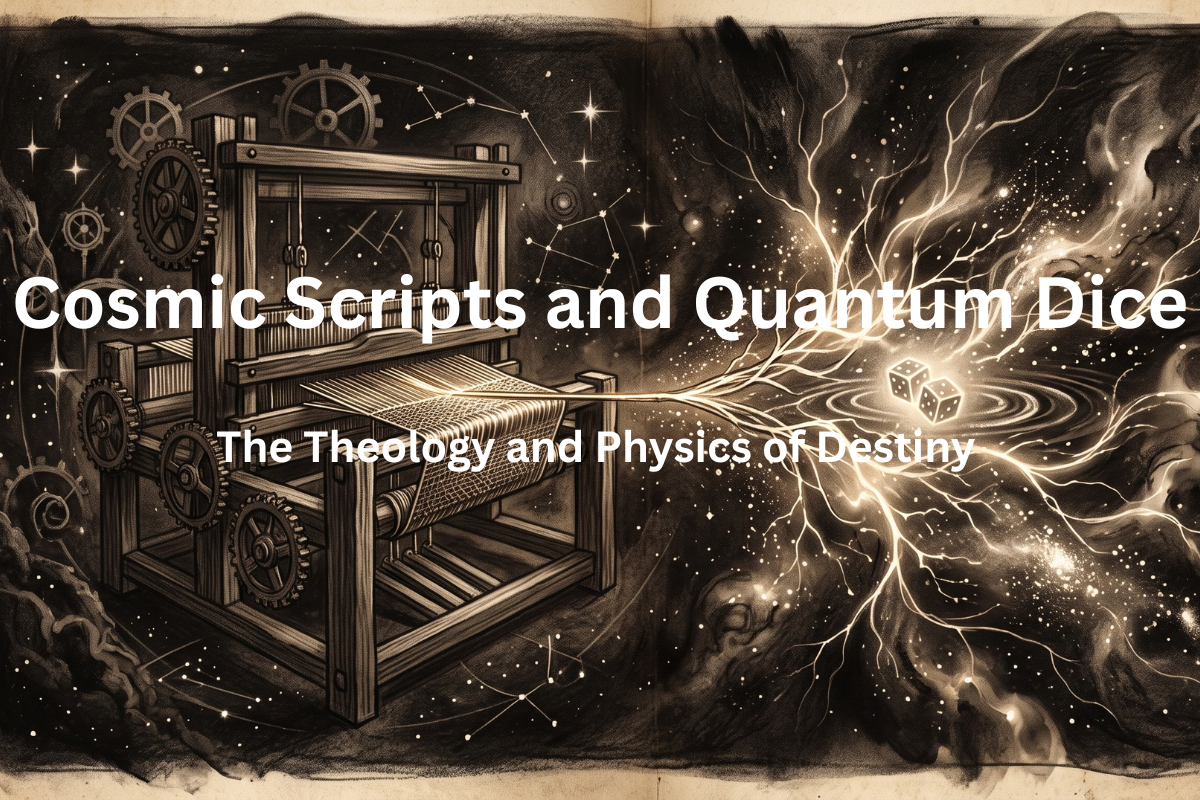
Cosmic Scripts and Quantum Dice: The Theology and Physics of Destiny
For centuries, theologians have wrestled with a paradox: if an all-knowing God governs reality, can human beings possess free will? In Christian theology, this tension split cleanly between Calvinism, built on divine foreordination, and Arminianism, which defends human agency and an open-ended future.
Modern physics ran into nearly the exact same problem. When we compare the old debate over determinism and free will to Einstein’s block universe and quantum uncertainty, it becomes clear that physics and theology are simply wrestling with the same mystery in different languages.
The Block Universe and Calvinist Foreordination
We intuitively assume time flows in one direction, like water down a river. Physics disagrees. Under Einstein’s theory of spacetime, the past and the future aren’t gone or waiting to happen; they are just sitting there. This is the “block universe” theory. Think of it less like a movie playing in a theatre and more like the actual roll of film in the projection booth. The opening scene and the credits already exist on the same plastic strip. From an outside perspective, your birth, right now, and the end of your life are simply fixed points on a single map.
This picture matches theological determinism, especially the Calvinist view of predestination. In Calvinism, God exists outside of time altogether, looking at the entire sweep of history in one glance. The future is foreordained and holds zero surprises, turns, or open paths. The script was finished before the first scene began. In both systems, the feeling that you are actively choosing your next step is mostly an illusion. Your path was laid out long ago.
Quantum Uncertainty and Arminian Free Agency
Down at the subatomic scale, physics is more complicated. Werner Heisenberg’s uncertainty principle and the standard interpretations of quantum mechanics tore up the idea of a clockwork world. Microscopic particles do not follow neat, guaranteed paths. Instead, they exist as clouds of possibilities and probabilities until an interaction happens and forces an outcome. The next moment genuinely is not settled until it occurs.
That idea gives defenders of free will, like Arminians, a surprisingly close physical counterpart. In their view, creation is not a frozen block of ice; it is an unfolding story where human choices carry weight. When a person stands at a moral crossroad, the future really is open. Much like a quantum state collapsing into a single definite result, human choice turns a cloud of potentials into a single fact.
The Shared Resolution: “Molinism” / “Many-Worlds”
The analogy goes even deeper when you look at how theologians and physicists try to fix the inherent flaws of both extremes.
In theology, a middle ground called Molinism (or Middle Knowledge) was proposed. It argues that God knows every possible choice a free creature would make in any given circumstance, allowing God to perfectly plan the universe without violating human free will.
In physics, this is almost identical to the Many-Worlds Interpretation of Quantum Mechanics. Instead of choice being an illusion (Calvinism/Block) or the universe being entirely chaotic and unpredictable (Arminianism/Uncertainty), the universe branches. Every possible quantum choice is actualized in its own distinct, deterministic block universe.
Two Languages for One Riddle
The analogy works so well because it exposes the fundamental limitation of human language and logic. Whether you are using the language of divine decrees or spacetime geometry, you are dealing with a static, timeless view of reality. Whether you use the language of libertarian free will or quantum mechanics, you are dealing with a dynamic, probabilistic view of reality.
Whether we argue using terms like divine decrees and free agency, or spacetime geometry and quantum wave functions, we are circling the same wall. Is time a river of genuine alternatives, or a finished sculpture where everything has already happened?
Science did not sweep away these theological debates; it translated them into equations. Whether you look through the lens of divine providence or modern physics, the central question remains the same: are we actively writing the plot, or simply reading our lines?