
Tracing the Spanish Soul: A Performance of Ritmo from Danses Andalouses
Andalusia is vibrant and energetic. You can feel it in the hot, dry air of the Guadalquivir Valley, see it in the bright and dark contrasts on Sevilla’s white buildings, and hear it in the strong beats of a flamenco dancer’s shoes. When Stella Goldenberg Brimo and I played Manuel Infante’s Ritmo, the first part of his Danses Andalouses, we aimed to show this lively spirit.
An Echo of Spain
I was instinctively drawn to Infante’s music. I am originally from the Philippines, which was under Spanish rule for over 300 years. For my contemporaries and two generations before me, Spanish culture was more than a subject of study; it was a part of our lives that touched all aspects of living. Performing Infante’s compositions felt like a link to our forebears.
I am currently studying the nature of leadership in a doctoral project at McGill University. I am particularly interested in ‘portable presence,’ the idea that communication can be rendered timeless through media. An example is the performance of Ritmo. Stella Brimo and I were creating a ‘presence’ of Andalusia and sharing it with our audience through Infante’s music. I never imagined that my wife Grace and I would one day journey to the very location where it all began and truly feel the emotions that Infante’s music evoked.
Ritmo and Infante’s Architecture of Rhythm
Manuel Infante lived in Paris for much of his life, but he always felt connected to Spain. He wrote Ritmo in 1921. This piece is an example of the “Spanish style” of piano music that was popular in the early 1900s.
The piece is called “Ritmo,” which means “rhythm.” It is marked Allegro moderato, and Infante provides an important direction: excessivement rythmé (very rhythmic). It copies the sharp, strong beats of flamenco, such as bullerias or zapateado (footwork). Unlike many Romantic pieces with flowing melodies, Ritmo is a precise two-piano toccata. The main “theme” is not just a tune but a beat that is repeated.
The Phrygian Sound Contour
Infante creates the “Andalusian Sound” in Ritmo’s driving pulse combined with the Phrygian mode. The composer uses the Phrygian Dominant scale, also known as the “Spanish Phrygian.” This scale is known for its unique raised third note. This creates a tense and “exotic” sound that drives the entire piece, moving between a feeling of ancient mystery and lively celebration.
This influence is most evident in two specific ways:
- First, it uses a musical pattern called Phrygian cadence. You can hear this in the quick back-and-forth chords that sound like a flamenco guitarist strumming. These chords usually end on a major chord after moving down by a half-step, giving the music a distinct “Andalusian” feel.
- Second, while much of the music is rhythmic, there moments of cante jondo when the melody becomes a “deep song.” Cante jondo uses a special scale to create musical decorations that sound like improvisation. These mimic the vocal decorations of flamenco singers.
From the Keyboard to the Cobblestones
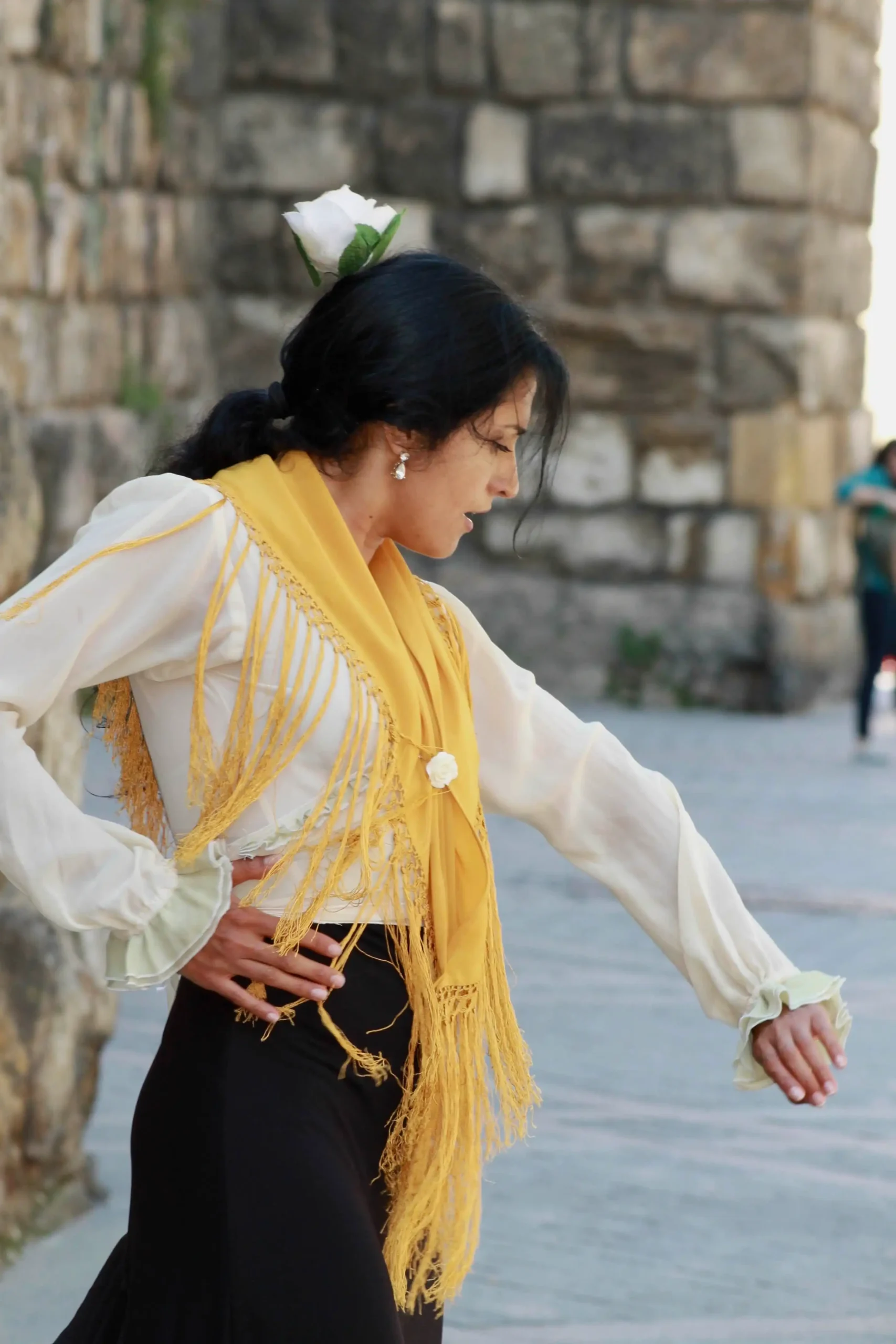
Years after performing Ritmo, my wife Grace and I finally had the opportunity to explore Andalusia. It was in the intimate setting of Casa de la Memoria in Sevilla that I finally understood the DNA of flamenco music. The setting was intimate, as if we were on stage with the performers. Two dancers, a man and a woman, moved with great energy. The singer performed passionate, complex songs, and the guitarist played masterfully, holding the performance together. In that setting, I reached back and thought about Ritmo. The “excessive rhythm” finally made sense to me. I realised we were not just playing notes; we were capturing the zapateado (footwork) and palmas (clapping) of the Spanish soul.
A Collaborative Memory
Performing Ritmo remains embedded in my memory and soul. In a two-piano setting, Ritmo is a high-energy conversation. The driving pulse ensures that the momentum does not waver. Technically, it is a test of synchronisation between two pianists. Beyond the rhythm, Ritmo evokes a centuries-old tradition passed down through generations.
I invite you to listen to our performance from a 2-piano recital in early 1990. I trust that the ‘portable presence’ created will indeed transport you to sunny Andalusia and allow you to vicariously experience the warmth and energy to be found there.