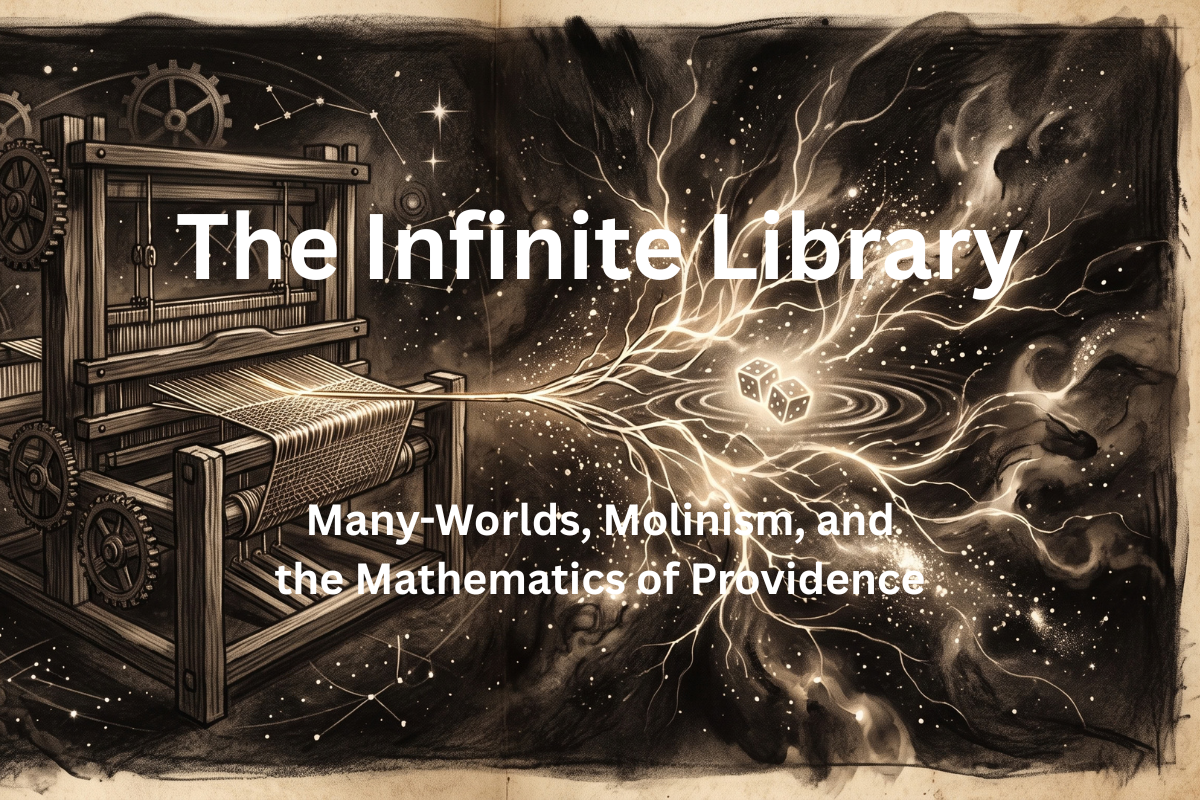
The Infinite Library: Many-Worlds, Molinism, and the Mathematics of Providence
In an earlier essay examining the parallels between theological foreordination and the block universe, we explored how classical determinism mirrors the static geometry of spacetime, and how human agency finds an unexpected physical analogue in quantum uncertainty. A deeper examination forces us to push that initial comparison to its outer boundary. If reality fractures every time a contingent choice is made, we do not merely confront a few diverging roads. We confront an explosion of them. The numbers run away from us immediately. Every subatomic interaction, every firing synapse, and every moral hesitation forces a clean break in the timeline, multiplying outcomes toward infinity. The Many-Worlds interpretation of quantum mechanics takes this multiplication quite literally, turning what feels like mere possibility into concrete, physical geography. What seems from our chair to be a singular, continuous life story is, under this view, nothing more than a solitary track running through an unimaginably dense thicket of alternatives. Yet this proliferation creates an acute structural dilemma for the physicist and the theologian alike. If every conceivable pathway is realised somewhere, how does the wider system preserve its internal coherence instead of degenerating into gibberish?
Quantum Decoherence and the Preservation of Order
To understand how modern physics handles this puzzle, one has to look closely at quantum decoherence. In the laboratory, we observe that subatomic particles do not inhabit distinct positions; they exist as clouds of probability, described by a mathematical equation known as the wave function. The moment that system interacts with its surrounding environment, those delicate overlapping probabilities leak into the wider world. The wave function does not vanish. Instead, it undergoes decoherence, meaning the phases of the wave scatter into the environment so thoroughly that different outcomes can no longer communicate with each other. They become mutually blind.
Picture a massive stone dropped into a quiet pool of water. The disturbance sends out an intricate pattern of concentric ripples that initially overlap and interfere. But imagine if each outgoing wave could somehow become entirely deaf to every other wave, proceeding outward on its own separate surface without ever crossing paths again. That is precisely how decoherence preserves order in a branching cosmos. You walk down one historical branch and find it completely consistent, entirely stable, and utterly unbroken by the alternative realities unfolding alongside you. The alternate you, having chosen a different profession, caught a different train, or married a different person, lives in an equally flawless, parallel coordinate. You never collide because the mathematics of quantum isolation acts like an impenetrable acoustic wall.
Whether these worlds form a countable collection or an uncountable continuum depends on the physics of the container. If the physical universe possesses finite volume and bounded energy, it can only contain a finite amount of information, a concept physicists describe through a finite Hilbert space. In that bounded scenario, the universe can only manifest a fixed ceiling of distinct quantum configurations, meaning that seemingly new branches must eventually repeat or overlap. But if the parameters of quantum geometry remain continuous, the branching is uncountably infinite. The result is an endless archive of four-dimensional blocks, each containing a settled, unalterable historical narrative from beginning to end.
Molinism and Counterfactual Foreknowledge
This vast modern schema would not have surprised sixteenth-century theologians, who wrestled with almost identical structural mechanics while debating the nature of divine omniscience. The central dispute lay between strict Calvinist foreordination, where history resembles a single, fixed script decreed before time, and the insistence that human beings possess genuine, unforced freedom. Into this deadlock stepped the Jesuit thinker Luis de Molina, who proposed a third category of divine awareness: scientia media, or middle knowledge. Molina argued that God’s knowledge comprises three logical moments. First, God knows all natural possibilities, every state of affairs that could theoretically exist. Third, by sovereign decree, God knows the actual world that was called into being.
Between those two moments sits middle knowledge. Through it, God knows with absolute clarity what any free creature would choose in any conceivable circumstance, prior to any decree to create. These hypothetical scenarios are known philosophically as counterfactuals of creaturely freedom. Before speaking the cosmos into existence, the divine intellect possessed an exhaustive, cinematic grasp of every branching path. In Molina’s theological framework, God did not merely draft a script for you and an isolated script for your neighbour, hoping their improvisations would align. God surveyed every complete, internally harmonious ecosystem of human decisions, down to the smallest detail, ensuring that every pathway held together without logical contradiction. In this respect, sixteenth-century Catholic theology developed a functional prototype of the multiverse long before quantum mechanics formalised it with matrices and wave equations.
The Universal Wave Function and Divine Providence
When we set these two systems side by side, the resemblance between the universal wave function and classical theology becomes striking. In quantum cosmology, the Everett wave function of the universe acts as the ultimate container of existence. It contains every physical state that has ever formed, every path that was abandoned, and every future that could unfold. From within a single branch, reality feels unpredictable, fragmented, and open-ended. But if an observer could step completely outside the entire multiverse, the total universal wave function does not shift, collapse, or experience hesitation. It evolves deterministically and smoothly, governed by the unbending structure of the Schrödinger equation.
Theological orthodoxy attributes an identical structural role to God. God is the ground of all being, existing outside of temporal flow, viewing the entire architecture of created history in a single, unhurried intuition. The turbulence, moral struggle, and apparent randomness of human experience belong entirely to the creatures living inside the timeline. From the divine vantage point, the whole fabric is settled, complete, and fully known. Both frameworks arrive at the exact same functional strategy to hold infinite variety together: they anchor the riot of local choices in a timeless, overarching ceiling of absolute order.
The Boundary of Intent: Mechanism versus Grace
Where the two worldviews part company is not over mathematics or geometric structure, but over intention. For the physicist, the universal wave function is a splendid, indifferent mechanism. It has no affection, no moral vision, and no telephone line open for human grief. It preserves order because it is mathematically incapable of doing anything else; the equations simply run their course. The branches separate because quantum decoherence suppresses interference, leaving each alternate version of yourself to wander down its lonely corridor of physical space without purpose or destination.
The Christian doctrine of providence makes a radically different claim about the nature of that governing ceiling. It insists that the ultimate container of reality is not an abstract equation, but personal agency characterised by justice and grace. The ordering principle of the universe is not mere mathematics, but a living intellect who knows every hair on the human head and every counterfactual pathway of the heart. Under this view, human agency is neither an isolated mechanical accident nor an exercise in futility; it is an active participation within a reality whose deep foundations were laid with love.
The tools of contemporary cosmology have not rendered the ancient inquiries obsolete. They have simply provided them with new notation, substituting Hilbert spaces and decohering vectors for scholastic distinctions and divine decrees. Whether one prefers the language of quantum mechanics or Reformed dogmatics, the central question remains standing before us, completely undisturbed: how an infinite array of fragile, contingent decisions can dwell inside an absolute, unified order without tearing the fabric of reality to shreds.
Where physical science meticulosly charts the indifferent mechanics of how an infinite cosmos hangs ogether, theology takes up the deeper, personal question of why it is held in being at all.