-
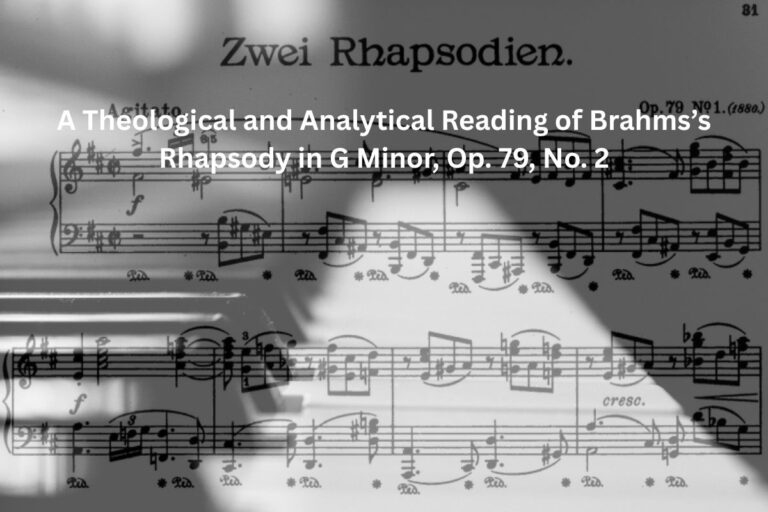
Structural Rigour, Prophetic Lament, and Divine Order: A Theological and Analytical Reading of Brahms Rhapsody in G Minor, Op. 79, No. 2
Johannes Brahms’s Rhapsody in G minor, Op. 79, No. 2 reveals a profound synthesis of technical architecture and Christian theological inquiry. Behind the tempestuous affect of its rhapsodic title lies a sonata-allegro structure that functions as an acoustic vessel of divine providence. Beginning in medias res with an accented submediant dissonance that withholds the tonic root, the composition articulates the physical trauma of Old Testament prophetic lament. The work subsequently traverses the desolation of Martin Luther’s theologia crucis through a hollow, octave-driven development section, counterbalanced by the communal memory of a secondary theme modelled on the Lutheran chorale. Evaluating the score alongside the divergent interpretive traditions of pianists such as Radu Lupu and Martha Argerich, this essay examines how Brahms disciplines existential grief within an unyielding sovereign container, ultimately resolving into a quiet, minor-mode eschatological vigil.
-
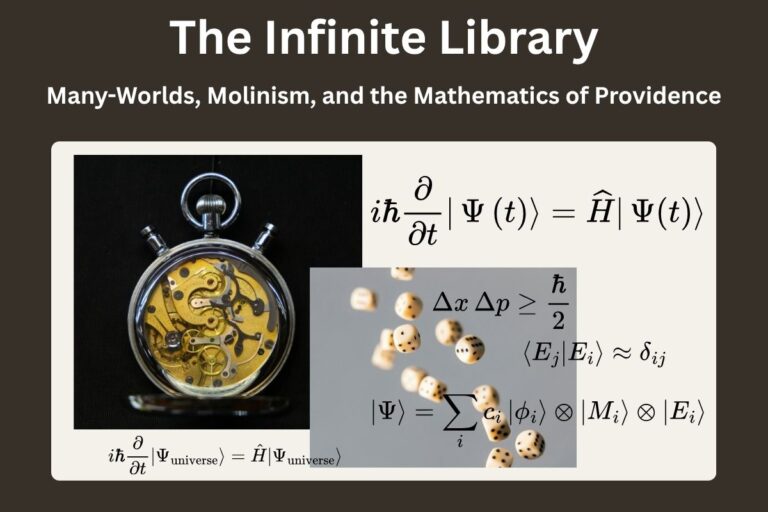
The Infinite Library: Many-Worlds, Molinism, and the Mathematics of Providence
A deeper examination of how quantum decoherence and the Many-Worlds multiverse parallel the theological concept of Molinist middle knowledge, exploring how infinite human choices remain anchored in an overarching, orderly reality.
-
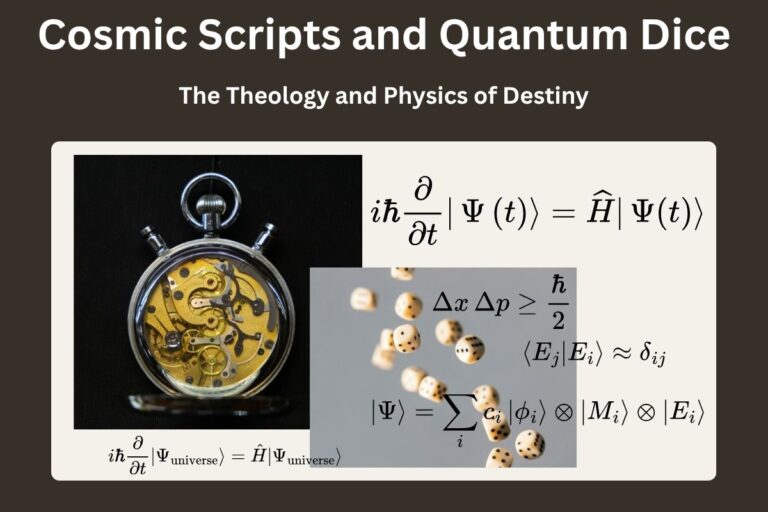
Cosmic Scripts and Quantum Dice: The Theology and Physics of Destiny
Does time flow like an unfolding river, or is reality a finished sculpture where past, present, and future already exist? In this essay, the classic divide between Calvinist predestination and Arminian agency meets Einstein’s spacetime and quantum indeterminacy, exploring how modern physics and ancient theology circle the exact same mystery of human destiny.
-
Tracing the Spanish Soul: A Performance of Ritmo from Danses Andalouses
Victor Gavino reflects on Ritmo from Danses Andalouse by Manuel Infante. Performing the music at a 2-piano recital with Stella Goldenberg Brimo. The soul of Andalusia brought to life in the music.
-
Journey to Easter: From Chopin’s Pathos of the Tomb to Mahler’s Shoreless Light
How does one transition from the sorrow of a funeral march to the uplifting light of the Resurrection? This piece examines Mahler’s Symphony No. 2, linking the deep feelings of Chopin’s Nocturne, Op. 48, No. 1, with Mahler’s expansive symphonic world. By looking at the changes in the medieval Dies Irae and the lightness of the choral ‘Misterioso,’ this article follows a musical journey from the sadness of the tomb to the joyful ‘Sunday’ of E-flat major. It reflects on how Mahler turns the mournful prayer of the grave into a bright promise of life.
-
The Master of Pathos: Chopin and the Blood-Stained Prayer in C-Minor
The Chopin Nocturne in C-minor, Op. 48, No. 1, is not merely a masterpiece of the Romantic era; it is a monolith of grief and a visceral, blood-stained prayer. In this Lenten meditation, we explore the ‘inexorable’ journey of a soul through the C-minor landscape of desolation, tracing the musical parallels to the biblical cries of Job, Jeremiah, and Jesus in Gethsemane. From the ‘noble dignity’ of the opening lament to the ‘bitter’ silence of the final chords, discover why this work remains one of the most emotionally devastating ever written for the piano.
-
Moses as Masterpiece: Identity and Leadership in the Greco-Roman World
During the Hellenistic and Greco-Roman eras, the reputation of Moses was contested, often maligned by non-Jewish critics. In response, Philo of Alexandria and Flavius Josephus crafted biographies that modified biblical accounts stylistically to elevate Moses’ status. By framing Moses within the classical traditions of “aretalogy” and “encomium,” they presented him as an idealized leader whose ancient traits, ranging from extraordinary wisdom to physical beauty, remain remarkably relevant to modern leadership models.
-
The Architect’s Anxiety: Between Robert Frost’s Design and the Tower of Babel
Explore Robert Frost’s “witches’ broth” of predation through a modern lens. Is the universe a “design of darkness,” or are our ideological boxes simply too small to grasp its complexity? From the Enlightenment’s “Tower of Babel” to the restorative peace of Isaiah, discover how we move from the arrogance of the architect to the awe of the observer.
-
Paul | leadership | Neuroscience | Science | sociology
The Missing Apostle: Addressing Knowledge Gaps in Pauline Leadership
Does modern leadership theory misread Paul? Explore the 3 critical knowledge gaps, from ‘Portable Presence’ to the neurobiology of the ‘Neural Handshake’.
-
From Goosebumps to Grace: The Power of Brahms’ Piano Masterpiece
Brahms’ Intermezzo in A Major, Op. 118 No. 2, is a quiet masterpiece of late‑life introspection, a work where tenderness, longing, and spiritual ambiguity converge. Blending personal reflection, musical insight, and the science of aesthetic “chills,” this essay explores how Brahms transforms private grief into a universal language of solace.
-
Theology | Beethoven | Music | Neuroscience | Science
The Resurrected Voice: How Beethoven’s Op. 110 Maps the Brain to the Soul
Neurophysiological and theological depths of Beethoven’s Piano Sonata No. 31. A musical ‘anastasis,’ bridging Catholic Enlightenment piety and modern brain science.
-
Crossing the Bar: Finding the Pilot in the Storm
Alfred, Lord Tennyson’s “Crossing the Bar” remains one of the most enduring meditations on mortality in English literature. Written in the final years of his life, the poem replaces the “moaning” of grief with the serene imagery of a ship putting out to sea. In this analysis, we explore the synthesis of Tennyson’s personal faith and his mastery of metaphor, examining how the “Pilot” and the “boundless deep” serve as a bridge between earthly existence and the transcendent homecoming of the soul.
-
church | leadership | Paul | Science | sociology
Beyond the Letter: Paul’s Narratives as Social Technology
How does a leader maintain influence when they are physically absent? This essay examines St. Paul’s “Portable Presence”—a sophisticated narrative strategy that allowed his authority and guidance to remain active within early Christian communities despite vast geographical distances. By synthesizing biblical studies with modern narrative leadership theory, we explore how Paul used his letters not just as correspondence, but as a technology of presence that continues to offer profound lessons for leaders navigating the complexities of remote influence and institutional identity today.
-
“Keep Practicing”: Lessons from a Legend
What can a piano teacher teach us about the ‘technology of presence’? Using the 1993 performance of Manuel Infante’s ‘Ritmo’ as a case study, Victor Gavino explores how legacy functions as leadership. Discover how a mentor’s influence becomes a ‘portable presence’ that continues to shape reality long after they have left the stage.
-
church | leadership | ministry | Science | sociology
The “Shelf-Life” of Leadership: Why Modern Models Fail Paul
Why does the Apostle Paul’s leadership still resonate 2,000 years after his death while modern corporate models often expire the moment a leader leaves the room? Victor Gavino challenges the limitations of Transformational and Servant leadership frameworks, proposing instead that Paul’s letters function as a ‘technology of presence’—a narrative vehicle that continues to build worlds long after the author is gone.
-
The Anchor of Faith: From Habakkuk to Luther
“Haunted by a world of chaos, the prophet Habakkuk asked: ‘Where is God?’ Discover the profound breakthrough that transformed Martin Luther’s despair into hope and explore the three divine answers that provide an anchor in the modern storm.”
-
The Primal Architecture of Leadership: From Darwinian Drives to Pauline Communities
“Leadership is not a modern corporate invention, but a stable evolutionary phenomenon. By mapping the Apostle Paul’s missionary behavior onto four Darwinian drives, we uncover the primal architecture of influence.”
-
The Numerical Reality of Church Decline in Canada: A 2021 Census Analysis
The 2021 Census confirms a definitive tipping point: weekly church attendance in Canada has plummeted from 65% to less than 9%. As the “Pastor-as-Manager” model fails, how can the local church transition to a “Narrative Presence”? This post analyzes the data of decline and introduces a new series on the theory of Narrative Leadership.
-
From Typhoons to Transformation: Finding Hope in a Factured World
“What does it mean to live in the ‘in-between’ time, where the world is broken but the New Creation has already begun? Drawing on the imagery of the Barong Tagalog and the theology of the Cornerstone, this post examines God’s promise to restore what is lost and calls us to weave Shalom into our neighbourhoods today.”
-
Why God? Why, God? The Journey from Despair to Advent Joy
Life is hard-wired for transcendence, always reaching for an echo of Eden. In this final sermon at Central Presbyterian, the language of music—specifically Beethoven’s Sonata No. 31—becomes a vessel for the Gospel. It is a journey through gasping laments and mysterious chords toward a strength seasoned by suffering and a hope that death never has the last word.
Retirement is also a beginning
On to the golden years