
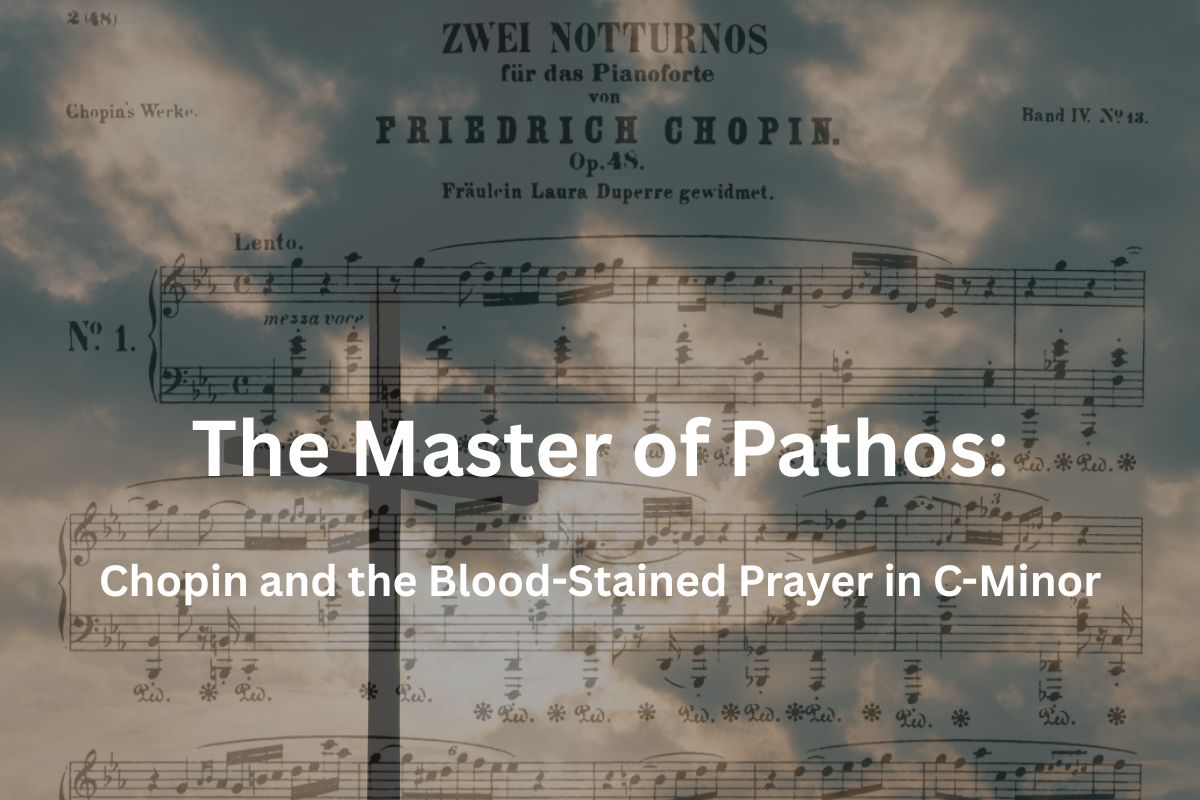
The Master of Pathos: Chopin and the Blood-Stained Prayer in C-Minor
The De Profundis of C-Minor
The Nocturne in C minor, Opus 48 No.1, composed by Chopin and dedicated to the Parisian socialite Mademoiselle Laure Duperré, was first published in 1841. It stands as one of the most emotionally devastating pieces Chopin ever wrote for the piano. Whether I am listening to it, playing parts of it, or simply reading the sheet music and singing it in my head, it never fails to envelop me completely, as if I am caught in a dark emotional grip of immense psychological weight. The Biblical allusions are inescapable, even if Chopin did not explicitly state there were any: the music is reminiscent of the Biblical cries of Job, Jeremiah, David, and Jesus in Gethsemane. It is a profound irony that this “scream for help” was officially dedicated to a Parisian socialite, Mademoiselle Laure Duperré.
The turbulent octaves promised a catharsis that never arrived. Instead of a breakthrough into light, they served as a bridge into a deeper hell.
This nocturne does more than sing; it captivates. It seizes the listener by the throat and heart, drawing the soul into a C-minor landscape of utter desolation. As we approach the shadow of Holy Week, this music feels less like a concert piece and more like a visceral, blood-stained prayer. It echoes the sound of a man standing at the brink of an abyss, demanding an answer that never arrives. The entire composition is heartbreaking, even with the prayer-like choral in the middle section that also dissolves into turbulence and anguish. It is Lent without any hope of Easter.
Claudio Arrau performs Chopin’s Nocturne Op. 48 No. 1, capturing the visceral pathos and noble dignity of the C-minor landscape. Note the ‘noble dignity’ in the opening and the ‘bitter finality’ of the conclusion.
Note: If prompted to ‘Sign In’ on mobile, simply tap the YouTube logo to view directly in your app. Search phrase: “Claudio Arrau Chopin Nocturne Op.48 No.1”
The first of the three sections resonates with a human voice, speaking through tears of profound exhaustion, yet retaining a noble dignity in its sorrow. The main theme in the treble is plaintive, halting, and gasping, yet it remains exquisitely eloquent in conveying distress and near hopelessness. The opening verses of Psalm 13 poetically express what the music evokes: “How long, O LORD? Will you forget me forever? How long will you hide your face from me? How long must I take counsel in my soul and have sorrow in my heart all the day?”
In this initial section, the emotional complexity is profound, intensifying the anguish of a tormented soul. Chopin achieves this by interspersing “glimmers of hope” that are repeatedly “shoved” back into despair. As early as the fifth measure, the music transitions to the E-flat major tonality, a key associated with heroism (as seen in Beethoven’s Eroica, which is in E-flat). It feels like finally standing tall, yet immediately after, the music collapses into the weaker and more melancholic G-minor. Then, at the tenth measure, it shifts to D-flat major, a key linked with rapture and ecstasy; this too is swiftly quenched, returning to the tragic minor tonality. Finally, a series of semiquavers makes a valiant attempt to soar high, yet everything keeps tumbling down as if violently weeping until this first section collapses into a deep bass C, as if all is ended.
A Sanctuary Invaded: The Chorale and the Rising Storm
Upon the somber tones of end of the first section, the second section descends like celestial messengers. It evokes the imagery of Luke 22:43, where, during Jesus’ agony in Gethsemane, “an angel from heaven appeared to him, strengthening him.” The tonality transitions from C minor to C major, and the harmony’s purity resembles a unified prayer. In the classical era, C major was synonymous with clarity, innocence, and peace. Yet, this seemingly tranquil sanctuary is soon disrupted by rumbling bass octaves that grow progressively violent. The music inexorably builds to an intense climax, which, in the classical era, would have been expected to lead to a cathartic release and a peaceful resolution in the recapitulative third section.
Gethsemane: The Agony of the Doppio Movimento
Yet, Chopin did not relent. The anticipated classical “cathartic release” is not merely absent but deliberately subverted by Chopin to reflect the intensifying torment of Gethsemane. Rather than a breakthrough into light, these moments serve as a passage into a deeper hell. The recapitulation does not signify a return to order; instead, it plunges into a frenzied, polyrhythmic chaos where the soul, once noble in its sorrow, is now engulfed by it.
In the recapitulation, the Doppio movimento, the original motif in the first section reappears in the treble where it once was, but now it seems desperately trying gasp for air above the blur and instability and the polyrhythm of a triple pulse layered above the double time of the bass. The right hand is at war with the left. This is where the turbulence and anguish truly explode. The plaintive, halting, and gasping theme of the beginning returns , but is now amplified by the near-violent octaves and the polyrhythmic struggle between the hands: a frantic state that mirrors the brink of an abyss. The allusion to Gethsemane continues: Even in the presence of the ministering angel, Jesus remained in agony: “…he prayed more earnestly and his sweat became like great drops of blood falling down to the ground” (Luke 22:44).
The climax unfolds six measures before the conclusion, marked by a sudden fortissimo chord that strikes like a desperate scream for help. This is the “De Profundis” moment, an anguished cry that remains unanswered. The harmonic tension between the A-flat and the C-minor foundation delivers a visceral shock, akin to the sound of someone hitting a wall and crying out in utter vulnerability.
Consummatum Est: The Silence of the Grave
The ending is famously bitter. Chopin withholds the comfort of a Picardy Third, as he does at the conclusion of the Nocturne No. 20 in C-sharp minor (posthumous). Instead, Op. 48 No.1 offers no transition to a bright major key at its close. The piece does not gently fade into a peaceful slumber; it collapses. The semiquavers in the third-to-last measure rise in tone yet convey a descent into silence. The melody no longer strives to soar or scream. It becomes a “letting go” and a “falling asleep.” It is akin to Jesus in John 19:30: “…It is finished, and he bowed his head and gave up his spirit.” The final chords are voiced low in the bass, blunt and short, resonating like the earth closing over a grave.
There is no “joy of the resurrection” here. Some griefs are not solved, but simply endured until they are finished.