
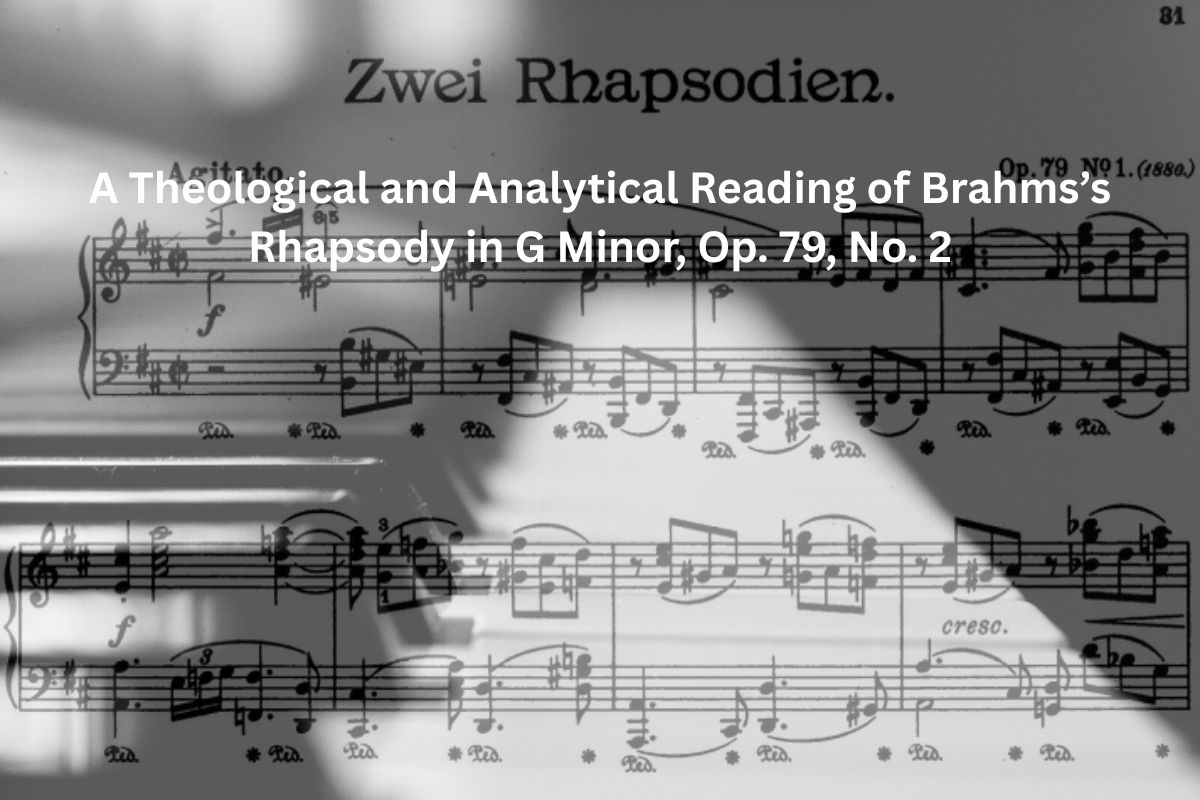
Structural Rigour, Prophetic Lament, and Divine Order: A Theological and Analytical Reading of Brahms Rhapsody in G Minor, Op. 79, No. 2
Introduction: The Performer’s Encounter
I first encountered the Rhapsody in G minor, Op. 79, No. 2, during my teenage years under the instruction of Corazon Arevalo-Coo, pianist-pedagogue. Preparing this score demanded more than digital dexterity; it required navigating an acute aesthetic friction between turbulent Romantic expression and uncompromising formal discipline. Having returned to this work across subsequent decades in public performance, the piece has consistently revealed itself to be far more than a virtuosic concert vehicle. It constitutes a profound musical discourse on human suffering, divine silence, and sovereign containment.
Johannes Brahms composed the two Rhapsodies of Op. 79 in the summer of 1879 at Pörtschach am Wörthersee. Although commonly regarded as a secular humanist whose personal religious convictions were marked by agnosticism, Brahms was formed within the North German Lutheran heritage. His daily reading of the Luther Bible and his lifelong devotion to the contrapuntal architecture of Johann Sebastian Bach left an indelible imprint upon his creative output. When subjected to harmonic, formal, and theological examination, Op. 79, No. 2 reveals itself not as an arbitrary outburst of 19th-century angst, but as a rigorously ordered theological treatise articulated in sound.
I. Musical Architecture: The Ironclad Container
The designation Rhapsody denotes an improvisatory, formally unbound effusion of heroic or poetic sentiment. Yet beneath this title, Brahms constructs an ironclad, strictly proportioned Sonata-Allegro form. This structural decision establishes the primary dialectic of the composition: erratic human affect constrained within an unyielding structural framework.
Table: Sonata-Allegro Form
|
Theme (Measures 1-32) |
Development (Measues 33-85) |
Recapitulation (Measures 86-118) |
Coda (Measures 119-131) |
|
|
|
|
|
|
|
|||
|
|
|
The exposition opens with an explosive, rhythmically displaced statement of the primary theme (mm. 1–13), followed by a brief, restless transition (mm. 14–20). The secondary subject enters at measure 21, shifting the tonal centre to D minor rather than the customary relative major of B-flat major.
The central development section (mm. 33–85) eschews typical heroic fragmentation. Instead, it systematically empties the acoustic space, reducing the musical fabric to spectral octaves moving across hollow fourths and fifths.
The recapitulation (mm. 86–118) restores the primary subject with doubled sonic violence, transposing the chorale-like second subject into the home key of G minor. Finally, the work concludes with a concentrated coda (mm. 119–131) structured over immovable pedal points, bringing the composition not to an ecstatic victory, but to a quiet, exhausted cadential resolution in the minor mode.
II. Harmonic Progressions and the Problem of the Opening
The harmonic syntax of measures 1–2 presents one of the most striking anomalies in nineteenth-century keyboard literature. In standard Classical and High Romantic syntax, a composition in G minor commences by establishing the tonic root.
In Wolfgang Amadeus Mozart’s Symphony No. 40 in G minor, K. 550, the melodic opening similarly features the minor-second cell E-flat to D, yet it is preceded by a stable accompaniment that outlines the G-minor pedal. The submediant functions as an upper neighbour to the structural fifth, grounded by a secure tonal foundation.
Similarly, Ludwig van Beethoven opens his Piano Sonata in C minor, Op. 13 (Pathétique), with a crushing root-position tonic chord prior to introducing any chromatic divergence.
Brahms dispenses with these foundations entirely. The anacrusis is an isolated, unaccompanied D. On the downbeat of measure 1, instead of resolving to a stable tonic triad (G to B-flat to D), the soprano vaults upward to an accented, prolonged E-flat, clashing directly against the low bass octave G.
The resulting vertical sonority acts as an inverted submediant that accumulates the pitch classes C and F-sharp within its turbulent inner figuration. This collection outlines the function of an augmented sixth chord or an incomplete diminished seventh.
Brahms forces the music to begin in medias res, presenting the predominant preparation and plunging immediately into the dominant seventh (D7) in measure 2 without having grounded the home key.
In the recapitulation (m. 86), Brahms does not resolve this initial ambiguity. Classical sonata practice typically normalises non-tonic openings by providing greater tonal grounding upon their return; Brahms preserves the identical, unresolved metric displacement.
Only in the coda is the fate of the E-flat decided. Here, the dynamic collapses from forte to piano, pianissimo, and eventually pianissimo misterioso. The assertive upward leap of the E-flat disappears. The motive is reduced to a descending two-note sigh, E-flat to D, which sinks step by step until the rhythmic impulse ceases altogether.
III. The Temperament of the Composition
The expressive disposition of the work is governed by its tempo indication: Molto passionato, ma non troppo allegro. The qualification ma non troppo allegro proves structurally decisive. When a performer reduces the piece to an athletic display of digital velocity, the physical gravitas of its metric displacements is entirely obscured. The temperament is shaped by persistent cross-currents embedded within the pianistic texture. In the bass, sweeping, wide-interval triplet figurations rumble beneath the primary thematic material, generating a continuous undercurrent of rhythmic instability and holy dread rather than classical equilibrium.
Concurrently, the treble voice traces chromatically inflected descending contours that directly recall the pathopoeia and suspiratio figures of Baroque rhetorical theory. These musical emblems of weeping and laboured exhalation operate in tandem with the sudden grand pauses that puncture the exposition. Rather than serving as mere dramatic rests, these caesuras act as rhetorical ruptures that break the musical discourse as though the speaker has been rendered breathless by an overwhelming grief. The prevailing temperament is thus removed from conventional romantic melodrama; it assumes the character of a solemn, catastrophic burden, evoking the terror and disorientation of a prophetic indictment.
IV. Theological Correlates
Prophetic Lament (Clamor ex Profundis)
In the Old Testament prophetic corpus, lamentation is neither sentimental nor tranquil. In the writings of Jeremiah and Habakkuk, prayer approaches judicial accusation.
When Habakkuk encounters the divine presence, he writes: “I hear, and my body trembles; my lips quiver at the sound; rottenness enters into my bones; my legs tremble beneath me” (Habakkuk 3:16).
The opening of Op. 79, No. 2 reflects this bodily and spiritual trauma. The plunging melodic contours correspond to Psalm 130:1: “Out of the depths I cry to you, O Lord!” The immediate deployment of the predominant E-flat embodies a breach of ontological peace: human grief speaks from within the rupture rather than from a posture of comfortable reflection.
Lutheran Chorale Echoes and Communal Memory
At measure 21, the frantic turbulence halts to introduce the secondary subject in D minor. The texture alters from sweeping arpeggiated figures into disciplined, four-part homophony.
While not an explicit citation of a historical hymn tune, the voice-leading evokes the syllabic solemnity of a sixteenth-century Lutheran chorale, recalling penitential settings such as “Aus tiefer Not schrei ich zu dir” or “O Welt, ich muss dich lassen”.
In Lutheran liturgy, the chorale serves as the voice of communal memory. When the individual believer is engulfed by sorrow, the corporate confession of the church provides a structural sanctuary.
Brahms restrains the vocal range of this theme and inflects it with a modal, Dorian character. It recalls the posture of Lamentations 3:21: “But this I call to mind, and therefore I have hope.” It is not an emotional release, but a sober recitation of covenantal trust spoken under trial.
The Theology of the Cross (Theologia Crucis)
Formulated by Martin Luther at the Heidelberg Disputation of 1518, the theologia crucis posits that God reveals Himself not through speculative splendour, worldly triumph, or radiant power (theologia gloriae), but sub contrario, hidden beneath suffering, weakness, and apparent abandonment.
The central development section (mm. 33–85) provides the sonic equivalent of this theology. Brahms drains the piano of rich, resonant thirds. The music evaporates into an eerie, hollow landscape of bare octaves, fourths, and fifths, whispered pianissimo.
This is the spatial desolation of Job 23:8–9: “Behold, I go forward, but he is not there, and backward, but I cannot perceive him.” It represents the kénosis of Philippians 2:7, the voluntary self-emptying of Christ, culminating in the cry of dereliction from the cross: “My God, my God, why have you forsaken me?” (Mark 15:34). Brahms offers no heroic triumph here; divine presence is encountered precisely in the terrifying void of divine hiddenness (Deus absconditus).
Sonata Form as Providential Order (Ordinatio)
The sonata-allegro form of the rhapsody operates as an acoustic manifestation of Divine Providence (ordinatio). Every measure remains held within an overarching, sovereign architectural boundary. This structural discipline reflects the divine containment established in Job 38:11, wherein the proud waves of the sea are stayed by divine decree. Human grief, no matter how chaotic or violent in its developmental crisis, is never permitted to exceed the sovereign container ordained for it.
This providential containment is brought to its architectural culmination in the coda through the deployment of extended pedal points. Over the protracted dominant pedal on D, the bass arrests the metric propulsion of the sonata form, locking the harmony into suspended animation. The upper registers continue to churn with unresolved chromatic fragments and weeping E-flat to D semitones, yet the immovable bass pedal denies the music any autonomous escape. Within Lutheran theology and the prophetic corpus, this dominant pedal embodies the Adventus and the suspense of waiting under judgment. It articulates the apocalyptic vigil of Habakkuk 2:1, wherein the soul stands at the watchpost in holy dread, incapable of engineering its own deliverance and waiting upon a resolution that can only be granted from beyond.
When the bass subsequently resolves to the low tonic G in measure 128, the harmonic texture undergoes a profound spatial transformation. Brahms drains the mid-register of warm harmonies, leaving an immense acoustic void between the subterranean pedal octaves and the quiet, fragmented gestures of the treble. This low tonic functions as the theological fundamentum, reflecting Deuteronomy 33:27, where the eternal God is revealed as an enduring dwelling place whose everlasting arms sustain the sufferer from beneath. The dynamic recedes into pianissimo misterioso, allowing the motivic sighs in the upper voice to expire over an unchanging tonal bedrock.
Crucially, Brahms refuses to conclude the composition with a Picardy third in G major. In the framework of Martin Luther’s theologia crucis, a triumphal major-key resolution would represent a premature theologia gloriae, claiming the fullness of resurrection triumph within the confines of present fallen history. By closing resolutely within an unadorned, quiet G minor, the work preserves the eschatological tension articulated in Romans 8:23. Creation continues to groan inwardly while awaiting its redemption. The sovereign architecture of the sonata form does not eradicate the reality of human lament; rather, it receives that lament, sustaining it until the sorrow dissolves into holy silence over an unshakable foundation.
V. Pianistic Interpretations: Performance Traditions as Hermeneutics
The performance history of Op. 79, No. 2 demonstrates how differing artistic temperaments engage this synthesis of emotion, form, and theology.
Radu Lupu: Mystical Desolation and the Theologia Crucis
Radu Lupu’s recording remains the closest sonic realisation of Luther’s theology of the cross. Lupu honours the ma non troppo allegro qualification, adopting an expansive tempo that avoids percussive virtuosity in favour of weight.
In the D-minor second subject, he withdraws the dynamic level into a veiled pianissimo, voicing the four parts with the quiet devotion of a cloistered choir.
In the development section, his articulation of the hollow octaves is disembodied, capturing the desolation of the Deus absconditus. Lupu understands that this music does not demand conquest, but contemplative surrender.
Arthur Rubinstein: Monumental Providence and Cosmic Order
Arthur Rubinstein approaches the work with aristocratic breadth. He refuses erratic fluctuations in tempo, maintaining an unyielding rhythmic architecture that projects the certainty of providential governance.
His opening E-flat arrives with majestic authority, less an existential question than a cosmic proclamation.
In the second theme, Rubinstein uses a warm, cello-like tone, transforming the chorale into a public, corporate liturgy rather than private prayer. His realisation of the coda’s low G tonic pedal is resolute, establishing an unshakable foundation beneath the tragic narrative.
Martha Argerich: The Volcanic Prophet
Martha Argerich occupies the opposite interpretive pole, unleashing the kinetic ferocity of the Molto passionato. Her anacrusis D detonates into the E-flat downbeat with terrifying speed.
For Argerich, the composition is an uninterrupted prophetic indictment, an outcry from the whirlwind.
The sudden grand pauses in her performance convey exhaustion, capturing the physical strain of wrestling with divine decree. Her development section remains charged with kinetic menace, demonstrating the terror of divine confrontation.
Glenn Gould: Polyphonic Purity and Bachian Determinism
Glenn Gould’s recording strips the composition of Victorian sentimentality. Utilizing minimal pedalling and a dry, quasi-harpsichord touch, Gould dissects the work’s contrapuntal anatomy.
The second theme is divested of Romantic cantabile, emerging instead as a rigorous, abstract chorale prelude reminiscent of Bach’s Art of Fugue.
Gould presents the sonata form as an unbending, mathematical determinism. Human lament is subordinated entirely to the purity of contrapuntal law.
Concluding Reflections
When I reflect on the years spent living with this score, from those formative adolescent lessons under Corazon Arevalo-Coo to repeated public performances, the enduring power of Op. 79, No. 2 lies in its refusal to offer facile consolation.
In my own study and performances of this compositon, I relate most intimately to the interpretations of Radu Lupu and Martha Argerich. Though their approaches might appear diametrically opposed, they articulate the two indispensable poles of the work’s spiritual dialectic. Argerich embodies the kinetic, uninhibited fury of prophetic lament; she hurls the opening E-flat into the void as an existential indictment, capturing the holy terror of Habakkuk. Lupu, by contrast, inhabits the inward desolation of the theologia crucis, drawing the chorale theme and the bare development section into a cloistered sanctuary of contemplative prayer and divine hiddenness. To interpret this piece faithfully requires holding both dimensions in tension: the external tempest of righteous accusation and the internal quietude of spiritual surrender.
Brahms presents us with an authentic anatomy of human grief. The initial E-flat gives voice to the raw, unvarnished trauma of living in a fractured creation. The chorale provides an anchor of communal remembrance. The hollow development leads the soul through the dark night of abandonment. Yet throughout this journey, the sonata form holds that sorrow within sovereign, providential boundaries.
As the final measures dissolve over the low tonic pedal, the music ceases not because the grief was trivial, but because the lament has been fully offered. In the silence that follows the final G-minor chord, one is left with the quiet assurance that while the storm is real, the foundation beneath it remains unshaken.
