The Scientist
I am convinced that a strong adherence to empirical truth not only preserves the sacred but also enhances its clarity. By delving into the workings of the world, we develop a more nuanced vocabulary to express its beauty. In these essays, I journey from the laboratory to the library, aiming to create a synthesis where data deepens wisdom and observation cultivates insight.
-
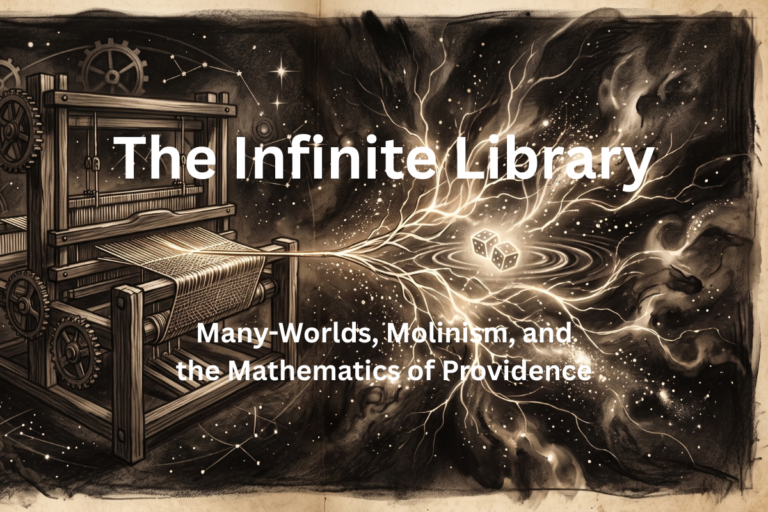
The Infinite Library: Many-Worlds, Molinism, and the Mathematics of Providence
A deeper examination of how quantum decoherence and the Many-Worlds multiverse parallel the theological concept of Molinist middle knowledge, exploring how infinite human choices remain anchored in an overarching, orderly reality.
-
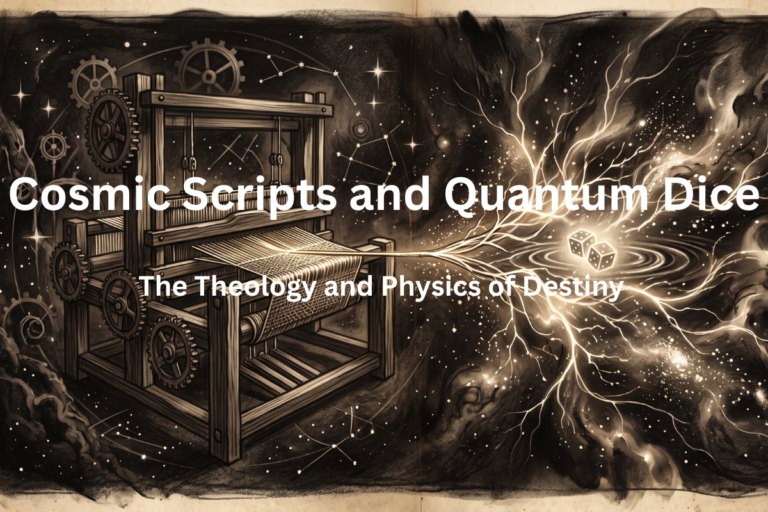
Cosmic Scripts and Quantum Dice: The Theology and Physics of Destiny
Does time flow like an unfolding river, or is reality a finished sculpture where past, present, and future already exist? In this essay, the classic divide between Calvinist predestination and Arminian agency meets Einstein’s spacetime and quantum indeterminacy, exploring how modern physics and ancient theology circle the exact same mystery of human destiny.
-
The Architect’s Anxiety: Between Robert Frost’s Design and the Tower of Babel
Explore Robert Frost’s “witches’ broth” of predation through a modern lens. Is the universe a “design of darkness,” or are our ideological boxes simply too small to grasp its complexity? From the Enlightenment’s “Tower of Babel” to the restorative peace of Isaiah, discover how we move from the arrogance of the architect to the awe of the observer.
-
Paul | leadership | Neuroscience | Science | sociology
The Missing Apostle: Addressing Knowledge Gaps in Pauline Leadership
Does modern leadership theory misread Paul? Explore the 3 critical knowledge gaps, from ‘Portable Presence’ to the neurobiology of the ‘Neural Handshake’.
-
Theology | Beethoven | Music | Neuroscience | Science
The Resurrected Voice: How Beethoven’s Op. 110 Maps the Brain to the Soul
Neurophysiological and theological depths of Beethoven’s Piano Sonata No. 31. A musical ‘anastasis,’ bridging Catholic Enlightenment piety and modern brain science.
-
church | leadership | Paul | Science | sociology
Beyond the Letter: Paul’s Narratives as Social Technology
How does a leader maintain influence when they are physically absent? This essay examines St. Paul’s “Portable Presence”—a sophisticated narrative strategy that allowed his authority and guidance to remain active within early Christian communities despite vast geographical distances. By synthesizing biblical studies with modern narrative leadership theory, we explore how Paul used his letters not just as correspondence, but as a technology of presence that continues to offer profound lessons for leaders navigating the complexities of remote influence and institutional identity today.